
30/04/2025 by Brian Donovan When David Murray was CEO of the fast-growing business Buildxact...
You found out in a meeting you were told about rather than asked into. Six weeks later you are standing in front of your own team, announcing it, in the voice of someone who chose it.
That is the hardest performance in senior leadership, and almost nobody says it out loud.
It has a shape. There are two change curves, and which one you are on comes down to one thing: whether you chose it.
Chosen change starts with a lift. For a while you can see all of the upside and none of the cost. Then the work arrives, the optimism deflates, and you climb out the other side.
Imposed change has no lift. It opens at shock and heads straight down.
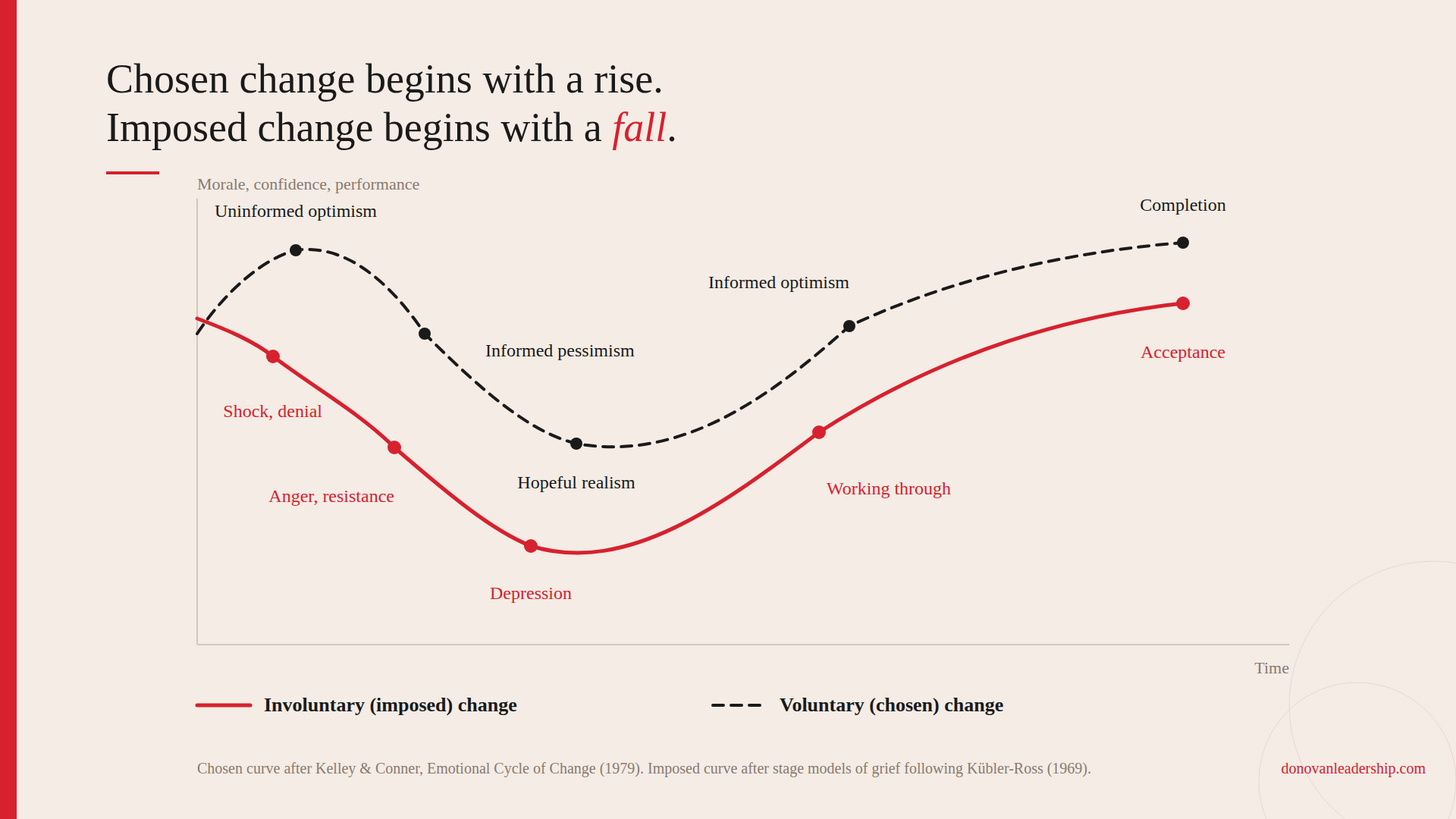
Whoever was in the deciding meetings entered on the top curve. Everyone else entered on the bottom one. And most senior leaders are on both at once — receiving upward, imposing downward, in the same week.
Which explains the senior exec who seems impatient you are not on board yet. Their descent happened privately, months ago. They are not early. They are further along a different line.
It also explains what you will see in your own team. Most of what you are calling resistance is a stage on a curve. Some of it isn't, and the difference matters — but you cannot tell which is which until you know where people are standing.
You can rarely make an imposed change voluntary. Usually the scope and funding arrived together, and neither is yours to move. What is still on the table is the sequence, and what gets stopped to make room for it. Trade in those honestly and people move toward the other curve. A consultation settled in advance doesn't count, and they can tell immediately.
It is also a team problem, not a stack of private ones. How the curve goes for one person depends on what their colleagues say in the corridor afterwards. Taking people through it one at a time rarely holds; shared words for where a team actually is will do more.
Neither curve is a law. Kübler-Ross spent her later years pointing out the stages were never a tidy sequence — people skip some and double back. The curve shows where someone is standing, not a schedule.
In your experience, what actually aligns a team behind a change?
A useful question is where your own influence actually sits when a decision lands on you. The Influence Curve quiz takes about four minutes.

